 LUDIA = AI + UDL

Universal Design for Learning
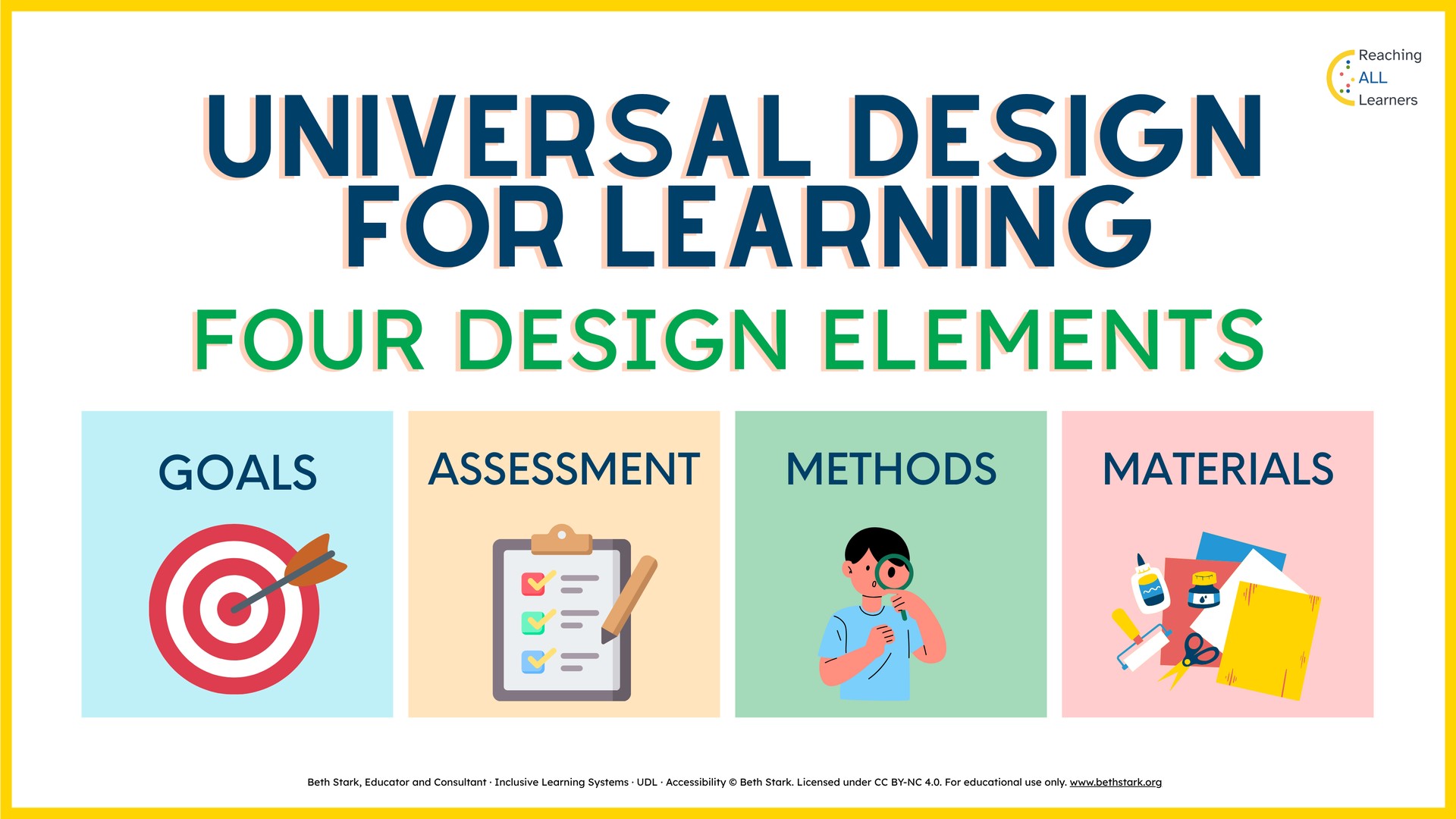
The Four Design Elements
Goals, assessment, methods and materials
About This Resource
Every UDL design has four elements: goals, assessment, methods and materials. UDL applies to all four, and the goal comes first (The IRIS Center, 2023a).

Goals
What it is: A goal tells learners what they should understand, know or be able to do by the end of a lesson or unit (The IRIS Center, 2023b).
What UDL Asks
- Keep the goal firm and the means flexible. The IRIS Center puts it this way: “goals must be separate from the means of learning” (2023b).
- Leave the method out of the goal. Naming one way of learning in the goal can shut out learners who find that way difficult.
- Share the goal with learners, so they can check their own progress.
Questions to Ask About Your Design
- Does the goal name what learners will know, understand or do?
- Does it leave room for more than one way to get there?
- Could a learner explain the goal in their own words?
On this site: Flexible Verbs for Crafting Goals
Assessment
What it is: Assessment is how we check learners’ progress toward the goal. It should measure the knowledge or skills the learning is designed to teach (The IRIS Center, 2023c).
What UDL Asks
- Measure the goal, not a barrier. If the goal is about science, a heavy reading load or a single required format can hide what a learner knows.
- Let learners show what they know in more than one way.
- Assess along the way, not only at the end, and give feedback that goes beyond right or wrong.
- Invite learners to assess and reflect on their own progress.
Questions to Ask About Your Design
- What exactly does this assessment measure? Is that the goal?
- What else does it demand that is not part of the goal?
- How will learners know how they are doing before the end?
On this site: Barrier or Important Factor? A Card Sort
Methods
What it is: Methods are the ways content is taught to help learners reach the goal (The IRIS Center, 2023d).
What UDL Asks
- No single method suits every learner. Use a variety of evidence-based methods, and adapt or combine them.
- Every method has strengths and possible barriers. Any method can be designed with UDL in mind.
- Give learners choices about how they work toward the goal, but not so many that the choices overwhelm them.
Questions to Ask About Your Design
- How does this method move learners toward the goal?
- Where might it create a barrier, and for whom?
- What real choices do learners have along the way?
On this site: The Barrier Is in the Design: Three Starting Points
Materials
What it is: Materials are the tools used to present content, such as books, lectures, videos, graphics and worksheets (The IRIS Center, 2023e).
What UDL Asks
- Choose materials that can change to fit learners. Fixed materials, such as a printed page, can be a barrier for some learners.
- Check that digital materials are accessible. A material is not accessible just because it is digital. It still needs things like alt text and captions.
- Look at the content as well as the format. Learners should see their own backgrounds and identities in what they learn.
Questions to Ask About Your Design
- Can learners change how the material looks or sounds, for example text size or text-to-speech?
- Do images have alt text, and do videos have captions?
- Whose stories, examples and voices are in the material?
On this site: Prioritizing Access and Addressing Bias and Designing for Identity
Keep Going
The IRIS Center’s module Universal Design for Learning: Designing Learning Experiences That Engage and Challenge All Students was developed with CAST. It has a page on each element, with examples and short videos.
This resource was created by Beth Stark, Educator and Consultant · Inclusive Learning Systems · UDL · Accessibility. Licensed under CC BY-NC 4.0.