
 Ask LUDIA
Professional learning
The Barrier Is in the Design
Three Professional Learning Routines for Your Next Staff Meeting or UDL PLC

At a Glance
- What it is
- Three short professional learning routines about one idea: the barrier is in the design, not in the learner.
- Who it is for
- Staff meetings, leadership teams and UDL PLCs. No prior knowledge of UDL is needed.
- What you need
- The slides and 10 to 20 minutes.
- What to do
- Choose one routine.
- Show the slides it names.
- End with the Companion Table slide.
This resource gives you everything you need to spark a constructive discussion about UDL at your next staff meeting, leadership team meeting or UDL professional learning community (PLC). Each professional learning routine is high-impact and low-prep, and no prior knowledge is required.
The Shift
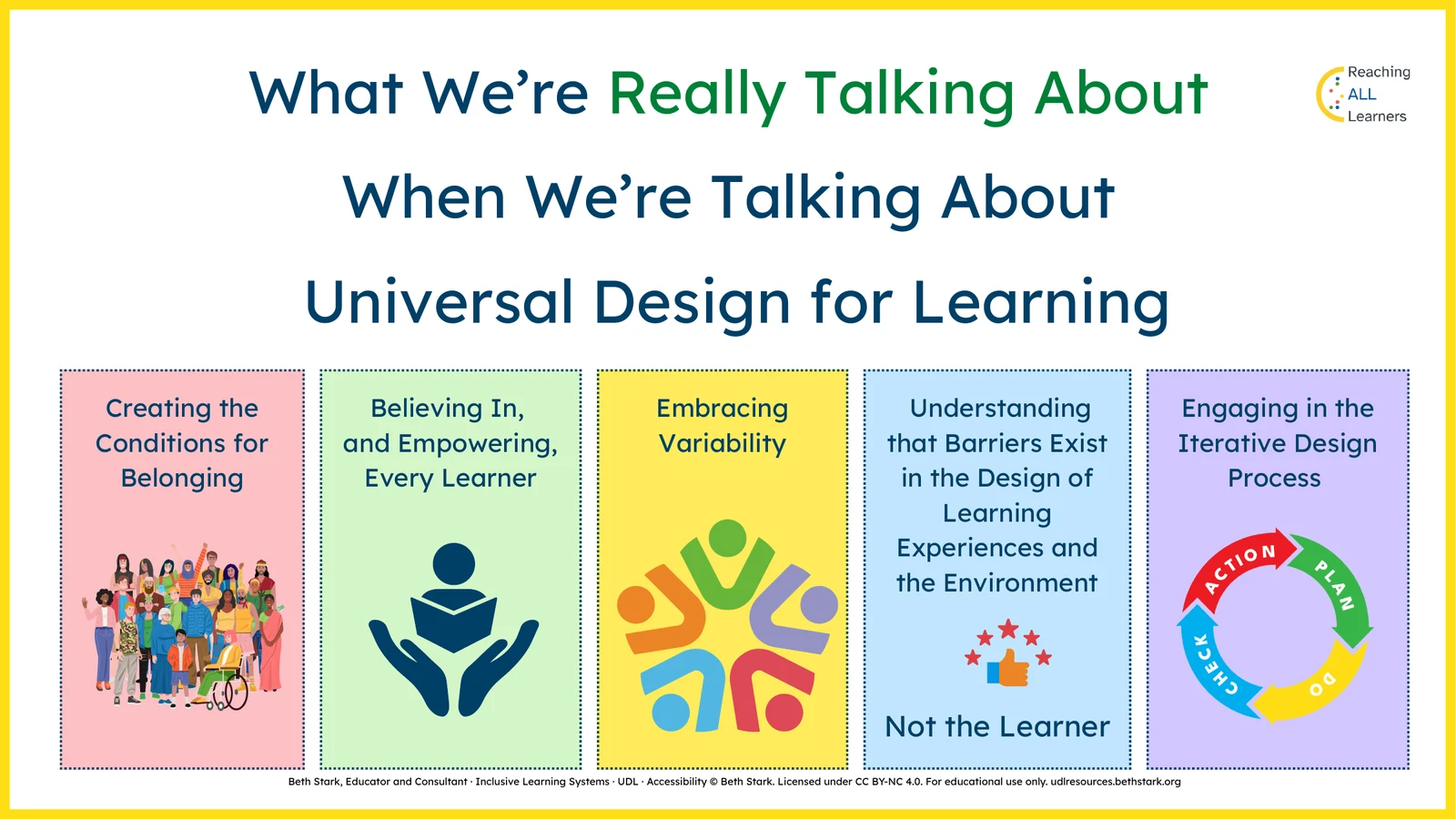
One of the core tenets of UDL is that barriers live in designs, not in students (The IRIS Center, n.d.). That single idea reorients everything. Instead of asking what is wrong with a learner, we ask: what are the barriers to learning, and how can we reduce them? Not once, but as the guiding force behind every decision about how learning experiences are structured, sequenced, and supported.
About this sample. This sample has one example from a collection of 20 barrier examples, with three professional learning routines for your next staff meeting or UDL PLC. The full collection is available to schools that work with Beth Stark. To ask about it, contact Beth by email.
Three Starting Points
Everybody deserves meaningful choice, especially when we are learning about UDL! Here are three professional learning routines to spark a UDL-centred discussion in your next meeting. Each one is designed to open a warm, honest discussion about barriers to learning and what they mean for the learners in your school. The starting point is always the design, never the individual.
| Routine | Time | Slides to show | How people work |
|---|---|---|---|
| Routine 1: We’ve All Been in This Room | 10 minutes or more | Slide 1 only | Think alone, then talk with a partner |
| Routine 2: The Missing Piece | 20 minutes or more | Slides 1, 2 and 3, one per group | Three groups |
| Routine 3: Two Truths and a Redesign | 15 minutes or more | Slides 1, 2 and 3 | Think alone, talk with a partner, then share with the whole group |
-
We’ve All Been in This Room
10 minutes or more
- Professional learning intention
- To open the conversation about design barriers by grounding it in our own experience as learners, before looking at classrooms.
- As you begin
- Show the Barrier Example slide only (Slide 1).
- Invitation to the group
Before we look at classrooms, let’s start here: when have you experienced this barrier yourself as a learner, in a meeting, a training, or a lecture? Take two minutes to think or jot something down, then share with a partner.
-
The Missing Piece
20 minutes or more
- Professional learning intention
- To deepen understanding of how the three elements of the resource connect, by reasoning from one piece toward the others before anything is revealed.
- As you begin
- Divide into three groups, with one slide for each group: Barrier Example (Slide 1), Barrier Clue Examples (Slide 2), and Possibilities (Slide 3).
- Invitation to the group
Your group has one piece of the puzzle. Spend five minutes: what do you think the missing pieces might be?
- Group one: what might learners do if this were the barrier?
- Group two: given these clues and possibilities, what is the barrier?
- Group three: given this barrier and these clues, what would you design?
-
Two Truths and a Redesign
15 minutes or more
- Professional learning intention
- To build on what your school is already doing well before identifying where a design change could make a difference, keeping the conversation asset-first.
- As you begin
- Show Slides 1, 2 and 3.
- Invitation to the group
Take two minutes on your own to identify two things your school is already doing well in relation to this barrier, and one thing you would redesign if you could. Share your two truths and your redesign with a partner, then we’ll collect one redesign idea from each pair.
After Any Routine
Show the Companion Table slide (Slide 4) to connect the conversation to the UDL Guidelines and Considerations.
The Barrier Example
The barrier example from the slides, with its companion table.
| Barrier Example | Barrier Clue Examples (Context Matters) | Possibilities for Reducing Barriers through Design |
|---|---|---|
| Explanations that deliver information to learners in extended blocks without pauses (in class). |
You may observe learners who…
|
|
Slide 4: Companion Table: UDL Guidelines and Considerations
This table names the UDL Guidelines and Considerations that inform the possibilities for reducing this barrier. Each consideration links to its page on the CAST UDL Guidelines website.
| Barrier Example | Engagement | Representation | Action & Expression |
|---|---|---|---|
| Explanations that deliver information to learners in extended blocks without pauses (in class). |
Design Options for Sustaining Effort & Persistence (8) Design Options for Emotional Capacity (9) |
Design Options for Language & Symbols (2) Design Options for Building Knowledge (3) |
Design Options for Expression & Communication (5) |
References
CAST (2024). CAST Universal Design for Learning Guidelines version 3.0. Retrieved from https://udlguidelines.cast.org
The IRIS Center. (n.d.). Page 2: Addressing barriers. In Universal Design for Learning: Designing learning experiences that engage and challenge all students. Peabody College, Vanderbilt University. https://iris.peabody.vanderbilt.edu/module/udl/cresource/q1/p02/
“The Barrier Is in the Design” by Beth Stark, Educator and Consultant · Inclusive Learning Systems · UDL · Accessibility. Licensed under CC BY-NC 4.0. The UDL Guidelines are © CAST.