
 Ask LUDIA
Universal Design for Learning
The Four Design Elements
Goals, assessment, methods and materials

About This Resource
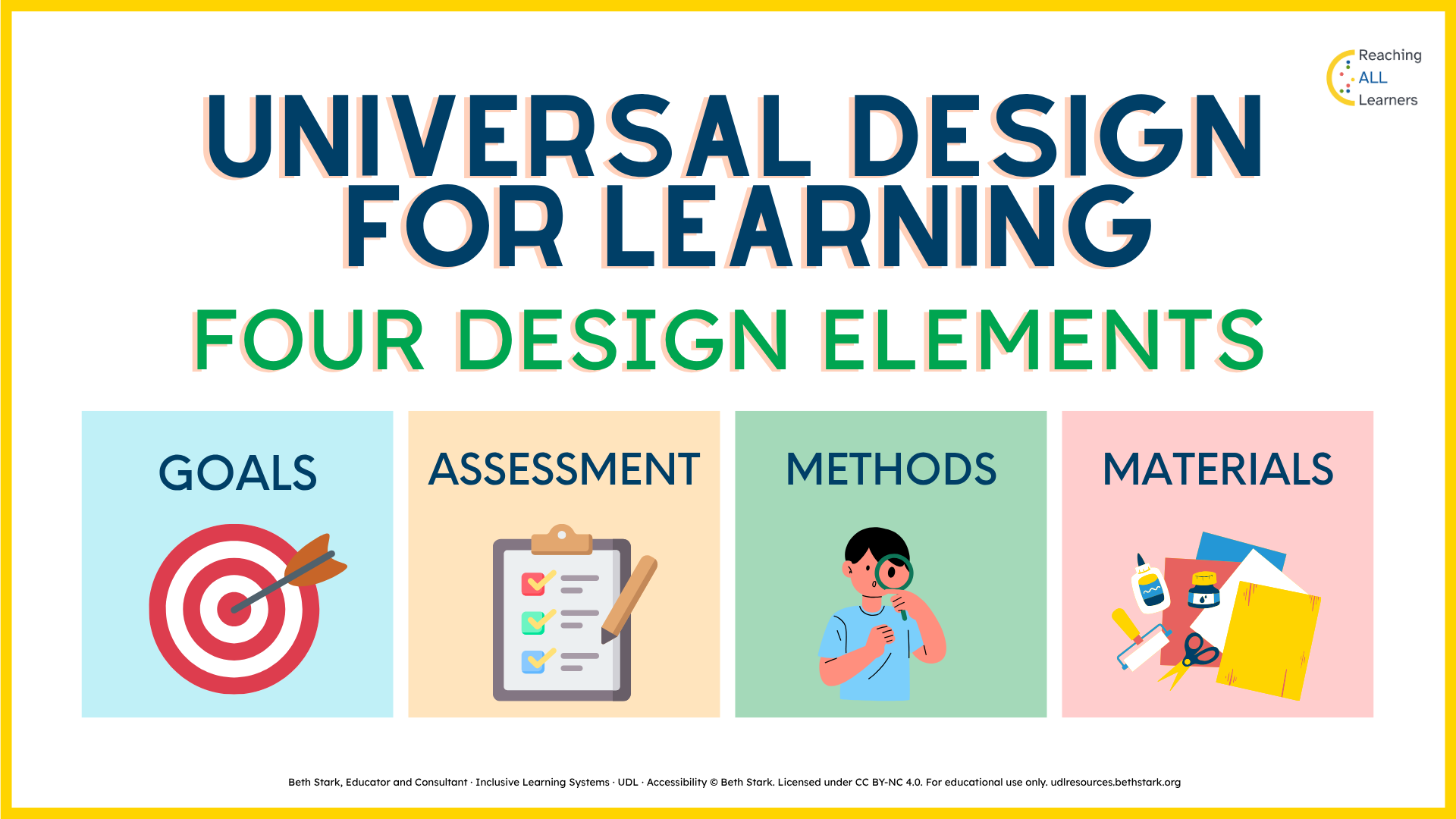
Every UDL design has four elements: goals, assessment, methods and materials. UDL applies to all four, and the goal comes first (The IRIS Center, n.d.-a).

Download the slide: PNG image or accessible PDF.
Goals
What it is: A goal tells learners what they should understand, know or be able to do by the end of a lesson or unit (The IRIS Center, n.d.-b).
What UDL Asks
- Keep the goal firm and the means flexible. The IRIS Center puts it this way: “goals must be separate from the means of learning” (n.d.-b).
- Leave the method out of the goal. Naming one way of learning in the goal can shut out learners who find that way difficult.
- Share the goal with learners, so they can check their own progress.
Questions to Ask About Your Design
- Does the goal name what learners will know, understand or do?
- Does it leave room for more than one way to get there?
- Could a learner explain the goal in their own words?
On this site: Flexible Verbs for Crafting Goals
Assessment
What it is: Assessment is how we check learners’ progress toward the goal. It should measure the knowledge or skills the learning is designed to teach (The IRIS Center, n.d.-c).
What UDL Asks
- Measure the goal, not a barrier. If the goal is about science, a heavy reading load or a single required format can hide what a learner knows.
- Let learners show what they know in more than one way.
- Assess along the way, not only at the end, and give feedback that goes beyond right or wrong.
- Invite learners to assess and reflect on their own progress.
Questions to Ask About Your Design
- What exactly does this assessment measure? Is that the goal?
- What else does it demand that is not part of the goal?
- How will learners know how they are doing before the end?
On this site: Barrier or Important Factor? A Card Sort
Methods
What it is: Methods are the ways content is taught to help learners reach the goal (The IRIS Center, n.d.-d).
What UDL Asks
- No single method suits every learner. Use a variety of evidence-based methods, and adapt or combine them.
- Every method has strengths and possible barriers. Any method can be designed with UDL in mind.
- Give learners choices about how they work toward the goal, but not so many that the choices overwhelm them.
Questions to Ask About Your Design
- How does this method move learners toward the goal?
- Where might it create a barrier, and for whom?
- What real choices do learners have along the way?
On this site: The Barrier Is in the Design: Three Starting Points
Materials
What it is: Materials are the tools used to present content, such as books, lectures, videos, graphics and worksheets (The IRIS Center, n.d.-e).
What UDL Asks
- Choose materials that can change to fit learners. Fixed materials, such as a printed page, can be a barrier for some learners.
- Check that digital materials are accessible. A material is not accessible just because it is digital. It still needs things like alt text and captions.
- Look at the content as well as the format. Learners should see their own backgrounds and identities in what they learn.
Questions to Ask About Your Design
- Can learners change how the material looks or sounds, for example text size or text-to-speech?
- Do images have alt text, and do videos have captions?
- Whose stories, examples and voices are in the material?
On this site: Prioritizing Access and Addressing Bias and Designing for Identity
Keep Going
The IRIS Center’s module Universal Design for Learning: Designing Learning Experiences That Engage and Challenge All Students was developed with CAST. It has a page on each element, with examples and short videos.
The Four Design Elements slide comes from a larger collection of professional learning resources. The full collection is available to schools that work with Beth Stark. To ask about it, contact Beth by email.
References
CAST (2024). CAST Universal Design for Learning Guidelines version 3.0. Retrieved from https://udlguidelines.cast.org
The IRIS Center. (n.d.-a). Page 3: UDL principles. In Universal Design for Learning: Designing learning experiences that engage and challenge all students. Peabody College, Vanderbilt University. https://iris.peabody.vanderbilt.edu/module/udl/cresource/q1/p03/
The IRIS Center. (n.d.-b). Page 4: Goals. In Universal Design for Learning: Designing learning experiences that engage and challenge all students. Peabody College, Vanderbilt University. https://iris.peabody.vanderbilt.edu/module/udl/cresource/q2/p04/
The IRIS Center. (n.d.-c). Page 5: Assessments. In Universal Design for Learning: Designing learning experiences that engage and challenge all students. Peabody College, Vanderbilt University. https://iris.peabody.vanderbilt.edu/module/udl/cresource/q2/p05/
The IRIS Center. (n.d.-d). Page 6: Methods. In Universal Design for Learning: Designing learning experiences that engage and challenge all students. Peabody College, Vanderbilt University. https://iris.peabody.vanderbilt.edu/module/udl/cresource/q2/p06/
The IRIS Center. (n.d.-e). Page 7: Materials. In Universal Design for Learning: Designing learning experiences that engage and challenge all students. Peabody College, Vanderbilt University. https://iris.peabody.vanderbilt.edu/module/udl/cresource/q2/p07/
This resource was created by Beth Stark, Educator and Consultant · Inclusive Learning Systems · UDL · Accessibility. Licensed under CC BY-NC 4.0.