
 Ask LUDIA
Universal Design for Learning
Prioritizing Access
Creating the Conditions for Learner Agency

About This Resource

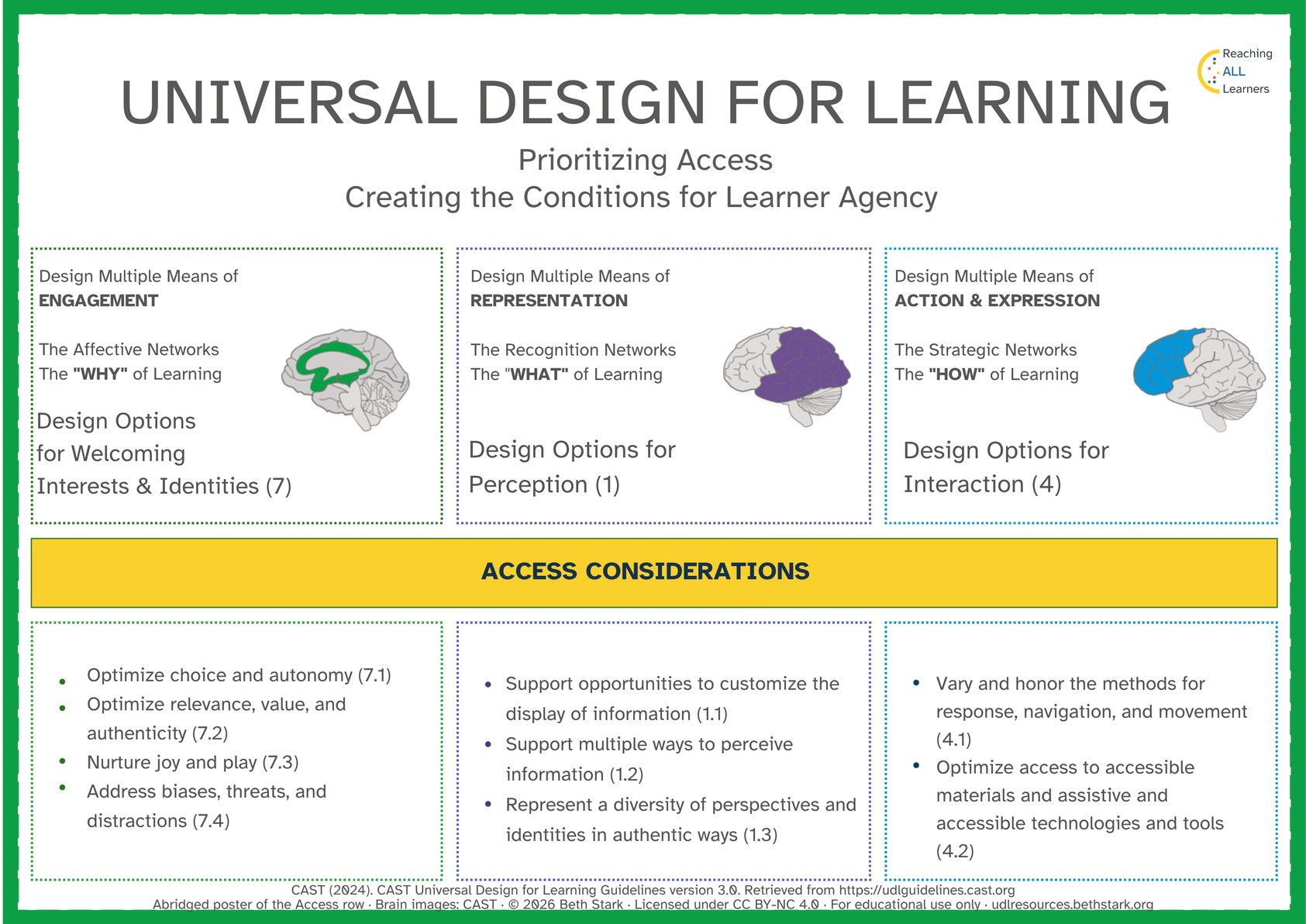
This is a shortened version of the CAST UDL Guidelines 3.0. It shows only the top row of the Guidelines, the Access row: one guideline from each of the three principles, with its considerations.
The full UDL Guidelines have nine guidelines and 36 considerations, across three rows: Access, Support and Executive Function.
Go to the full CAST UDL Guidelines
How to Use This Page
- The picture is the original poster. The text version below it has every word from the poster.
- The guidelines and considerations use CAST's exact words and numbers.
- Each consideration links to its page on the CAST UDL Guidelines website.
- The visual version PDF matches the poster. Use the accessible PDF with a screen reader.
- Links to other sites open in a new tab.
Text Version
Access
The top row of the CAST UDL Guidelines 3.0. The Support and Executive Function rows are on the CAST UDL Guidelines website.
Design Multiple Means ofEngagement

Affective networks: the why of learning
Design Options for Welcoming Interests & Identities (Guideline 7)
Design Multiple Means ofRepresentation

Recognition networks: the what of learning
Design Options for Perception (Guideline 1)
Design Multiple Means ofAction & Expression

Strategic networks: the how of learning
Design Options for Interaction (Guideline 4)
The principle, guideline and consideration names are CAST's own words from the UDL Guidelines 3.0, so they keep CAST's US spelling. The brain drawings and the network labels come from the poster. The CAST UDL Guidelines 3.0 website does not use these labels.
Reference
CAST (2024). CAST Universal Design for Learning Guidelines version 3.0. Retrieved from udlguidelines.cast.org
This resource was created by Beth Stark, Inclusive Learning Systems. Licensed under CC BY-NC 4.0. The UDL Guidelines are © CAST.